
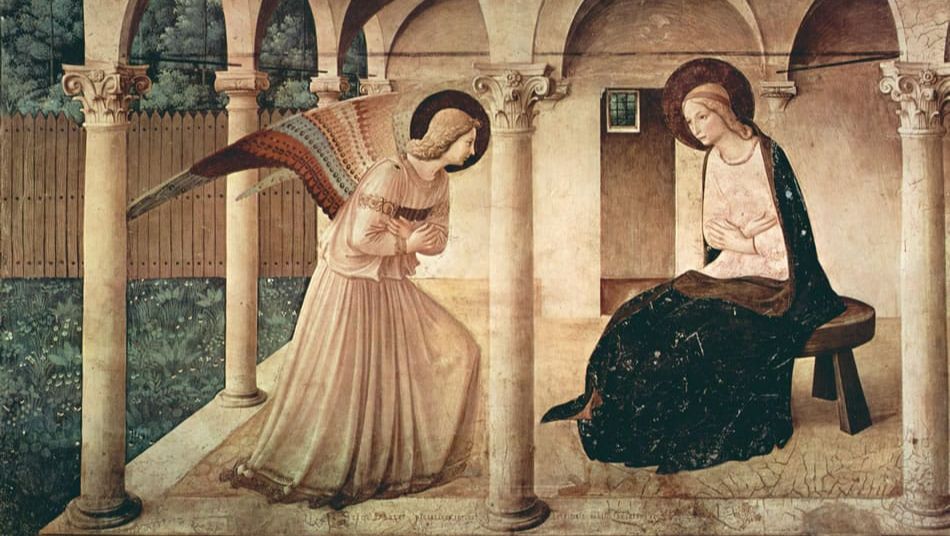
 The teaching of the Virgin Birth is primarily a statement about who Jesus is. The Gospels of Matthew and Luke both tell that Jesus was born of a virgin. While Matthew’s story focuses on the character of Joseph, Luke’s focus is on Mary. Both narratives and the Creed reflect upon the human and divine origins of Christ.
Matthew describes how an angel appears to Joseph in a dream reminding him of Isaiah’s prophecy: “A virgin shall conceive and bear a son, and he shall be called Immanuel.” This prophecy from six centuries before Christ’s birth was originally understood to refer to a new king in David’s line. Matthew asserts that God’s prophecies have an importance that extends beyond the concerns of the present. In Luke’s story of the Annunciation, the angel Gabriel appears to Mary, who freely gives her consent to God’s plan: “Behold, the handmaid of the Lord; may it be done unto me according to thy word.” The Second Vatican Council insisted that Mary was “not a passive instrument (Lumen Gentium §56).” The miraculous conception of Christ was not something that was done to her, rather, she actively cooperated with Grace. While the two narratives are very different, both Matthew and Luke sought to connect Christ to the Davidic dynasty, and key to both narratives was the Spirit’s role in his conception. Jesus was one with God from the beginning. He did not become God as time went on, nor was he merely an adopted Son. Both stories make clear that God works in unexpected ways to advance the course of salvation history.
0 Comments
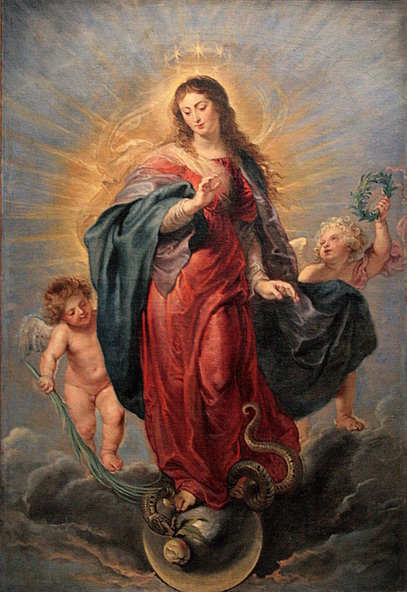 In 1476 Pope Sixtus IV approved the Feast of the Immaculate Conception of Mary celebrated each year on the 8th of December. Pope Pius IX issued a document, Ineffabilis Deus, in 1854 defining the dogma stating that Mary was free from sin from the moment of her conception. This teaching has a long and complicated history. The key idea is that Mary experienced a unique call to be the Mother of God. From the very beginning of her life she had an intimate relationship with God. Her role is special because of her connection with Christ. The moon does not create its own light and only reflects the light of the Sun. Likewise she reflects the light of her son and is normally shown standing on the moon, like she is in the painting above by Peter Paul Ruebens. The dogma of the Immaculate Conception means that Mary was special in a very unique way. She was blessed with a greater and deeper relationship with God. Another way of saying this is that God was more present to her than to anyone else because she was the God-bearer the very Mother of God himself. This dogma reminds us that God is gracious to us not based on our own merits but based on his mercy and love.
|
AuthorWrite something about yourself. No need to be fancy, just an overview. Archives
January 2018
Categories
All
|
 RSS Feed
Proudly powered by Weebly