
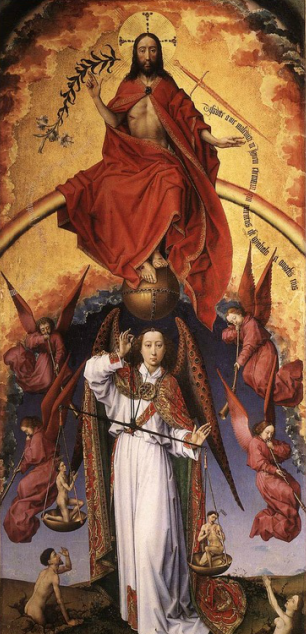
 The teachings of the Church about the last things are teachings about humanity. The point is that people are created for a future with God but they are absolutely free to decide if they will participate in that future. The future has not yet been experience but it is being realized now. We do not pretend to know everything about it nor do we need to. What our tradition has done is make certain conclusions based on our experience of the present. Primarily, we believe that the person is not abolished by death but rather transposed into another mode of living.
There are many poetic images that we use to communicate something about this. We recognize that we do not have eyewitness from the future that is why images such as angels and their trumpets, or Christ dividing the sheep from the goats are used. Poetic images are one thing and the content or meaning of them is another. We need to reflect on the meaning behind the images. Our tradition teaches us that there will be an individual judgement at the moment of death and some kind of communal judgement when Christ comes in glory at the end of history. The Council of Florence (1439) taught that after the individual judgement at death, unless in need of purification, people “see clearly…as God is, though some more perfectly than others, according to the diversity of merits” emphasizing that human differences matter and our decisions matter in an ultimate way. The idea of judgement presents the possibility of Hell. This is a troubling recognition that we cannot avoid the ambiguity of our own lives simply by flippantly saying everyone is saved. The great theologian Karl Rahner wrote that we should not try to say too much about it either, “we neither can nor must say anything about the end of an individual who suffers final loss except that a person who is still living in history and is just now exercising his freedom must reckon with this possibility…” What we do know is that God grants people freedom to respond to his love or live a totally isolated existence. Purgatory is the “process by which we are purged of our residual selfishness so that we can really become one with the God who is totally self-giving.” The Church recognizes the possibility of maturation and growth after death. We do not see this as punishment but rather a surrendering our self-centered idea of who we are so that our God-centered existence may begin. During Advent many of the readings touch on these themes. We recognize that Christ experienced death and even preached the Gospel to the dead. His redemptive work extends to people of all times and places. As the Provincial Council of Quiercy stated in 853, “there is not, has never been, and never will be a single human being for whom Christ did not suffer.”
0 Comments
“O come, O dayspring from on high, and cheer us by your drawing neigh…” Our churches are decorated purple with the color of the night sky just before dawn and resound with hymns from centuries past. The longest coldest nights are during this season and the green of the summer has been put away. While we await the arrival of morning we cannot ignore that this is a season of greater darkness. This is our experience of beginnings and ends. This is how we celebrate the arrival of new things, we wait in hope.
During advent we are presented with an image of Christ who is both final judge and infant in his mother’s womb. We are reminded that the action of Jesus the Christ is the action of ‘The Origin’ entering into Time. The truth of history is brought to the light of day by his birth. The way Christ comes into the world presents a model for all people. What is to be done, what has taken place, what is to take place are all shown in this one life. “Christ may be born in Bethlehem a thousand times, but if he is not born in you, you will be lost for all eternity just the same.” During advent we prepare for the Incarnation and recognize that it also depends on if we decide to embody it in our lives. Will we allow Christ to be born in us? Will we see our neighbor as someone beloved by the father? Are we willing to see ourselves as God see us? How will we treat the ultimate reality when it comes to meet us? The life of Christ shows us there has to be a transformation of the temporal, a transformation of the ordinary. It is not good enough to simply do the same as I have always been doing. Now is the time to start again seriously. I must learn to wait in the present and listen to the eternal. I must learn to see myself as Christ sees me, to see my neighbor as Christ sees him. We must learn how to await a future that is always coming. No moment is totally fulfilled. Everything is pointing beyond itself. During this season we sense the approach of something final. The purple night unveils the reality of a star rising in the East. This is our invitation to respond to a call for a renewed attempt to give bodily form to the idea of Christ. This is a season pregnant with Christ’s return in judgement. The return will be the precise expression of the final implementation of what has already and always been taking place within history. We need to see our role in the fluid motion coming from God and returning to him. "Veni, veni, O Oriens; Solare nos adveniens...” |
AuthorWrite something about yourself. No need to be fancy, just an overview. Archives
January 2018
Categories
All
|
 RSS Feed
Proudly powered by Weebly